
Imagine building a company that protects the oceans, creates jobs, fights climate change, and earns money at the same time. That’s exactly what the Blue Economy is all about.
For students and Gen Z, there has never been a better time to start a Blue Economy startup. New technologies like Artificial Intelligence (AI), drones, robotics, satellites, blockchain, and IoT are transforming how we manage our oceans and coastlines. You don’t need to own a fishing boat or live near the sea to become a Blue Economy entrepreneur. You simply need a problem worth solving.
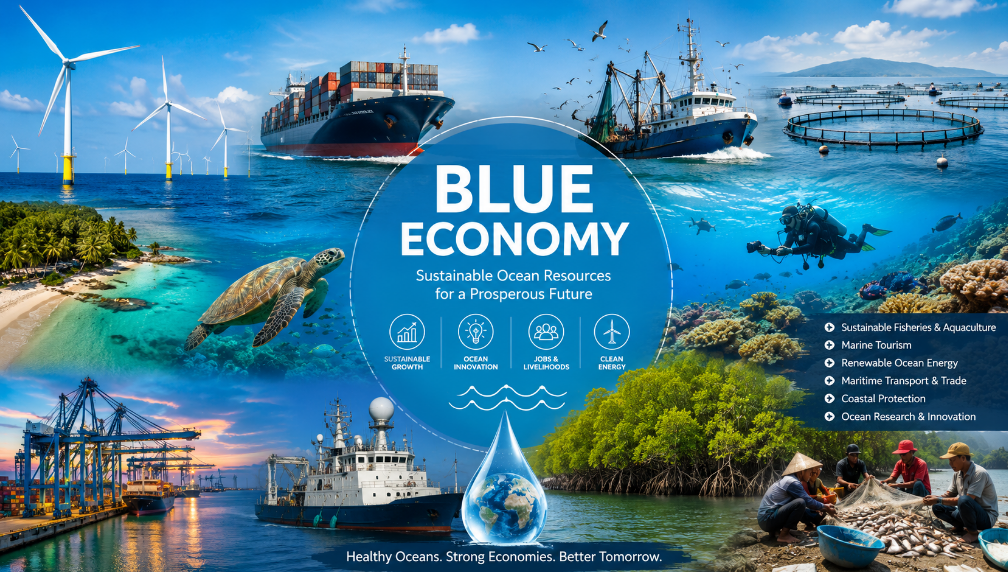
What Is the Blue Economy?
The Blue Economy refers to the sustainable use of ocean, sea, and coastal resources to create economic growth while protecting marine ecosystems.
It focuses on balancing three goals:
- Economic growth
- Environmental sustainability
- Better livelihoods for communities
Think of it as building businesses that help both people and the planet.
Why Should Students Care?
The ocean covers more than 70% of Earth’s surface, yet many industries connected to it are still waiting for innovation.
Young entrepreneurs can solve challenges such as:
- Plastic pollution
- Overfishing
- Coastal flooding
- Marine biodiversity loss
- Sustainable seafood production
- Clean ocean transportation
- Renewable ocean energy
Every challenge is also a business opportunity.
Blue Economy Startup Ideas
Here are startup ideas that students can begin exploring.
The Blue Economy offers exciting opportunities for students to build innovative businesses that protect the oceans while creating economic value. With technologies like AI, IoT, blockchain, robotics, and data analytics becoming more accessible, young entrepreneurs can develop impactful startups that solve real-world marine challenges.
1. Ocean Cleanup Technology
Plastic pollution is one of the biggest threats to marine ecosystems. Students can develop AI-powered drones, autonomous boats, or underwater robots that detect, collect, and monitor floating plastic waste. These technologies can help governments, NGOs, and environmental organizations clean oceans more efficiently while reducing the cost of manual cleanup operations.
2. Smart Fisheries
Artificial Intelligence can transform traditional fishing into a smarter and more sustainable industry. A mobile application can help fishermen predict fish locations using satellite data, monitor weather conditions, receive storm alerts, and compare market prices before selling their catch. This improves safety, increases income, and helps prevent overfishing.
3. Sustainable Aquaculture
Fish farming is becoming increasingly important to meet global seafood demand. Students can build IoT-based monitoring systems that measure water quality, temperature, oxygen levels, and feeding schedules in real time. These smart solutions help fish farmers reduce waste, improve productivity, lower operating costs, and maintain healthier aquatic environments.
4. Marine Renewable Energy
The oceans are a powerful source of clean energy. Entrepreneurs can create software platforms, monitoring systems, or engineering solutions that support offshore wind farms, tidal energy, and wave energy projects. These innovations contribute to renewable energy production while reducing dependence on fossil fuels.
5. Blue Carbon Solutions
Coastal ecosystems such as mangroves, seagrass meadows, and salt marshes naturally absorb large amounts of carbon dioxide. Students can develop AI-powered monitoring platforms, satellite mapping tools, or environmental dashboards that help governments and conservation organizations track these ecosystems, measure carbon storage, and support climate action initiatives.
6. Eco-Tourism Platforms
Sustainable tourism is growing rapidly around the world. Young entrepreneurs can build digital platforms that connect travelers with eco-friendly coastal experiences, local guides, community-based accommodations, and conservation activities. Such platforms encourage responsible tourism while creating economic opportunities for coastal communities.
7. Blockchain for Seafood Traceability
Consumers increasingly want to know where their seafood comes from. A blockchain-based platform can track seafood throughout the entire supply chain—from fishing boats and processing facilities to retailers and restaurants. This improves transparency, reduces seafood fraud, supports sustainable fishing practices, and builds consumer trust.
8. Ocean Data Analytics
Oceans generate enormous amounts of environmental data every day. Students can create AI-powered analytics platforms that process information from satellites, sensors, weather stations, and marine research. These insights can help governments, scientists, conservation groups, and businesses make informed decisions about marine conservation, disaster preparedness, and sustainable resource management.
The Opportunity Ahead
The Blue Economy is expected to become one of the world’s fastest-growing sectors, creating opportunities across technology, sustainability, logistics, renewable energy, tourism, and environmental conservation. For students, it represents more than just a business opportunity—it is a chance to build startups that generate profits while protecting our oceans for future generations. By combining innovation with environmental responsibility, today’s young entrepreneurs can play a significant role in shaping a more sustainable blue future.
Skills You Need
You don’t have to master everything before you begin. Start with the basics and keep learning.
Useful skills include:
- Entrepreneurship
- Problem-solving
- AI and Machine Learning
- Data Analytics
- GIS and Mapping
- IoT
- Robotics
- Drone Technology
- UI/UX Design
- Mobile App Development
- Digital Marketing
These skills are valuable across many industries, not just the Blue Economy.
How to Start a Blue Economy Startup
Step 1: Find a Real Problem
Talk to fishermen, marine researchers, shipping companies, tourists, and coastal communities.
Ask questions like:
- What wastes the most time?
- What costs the most money?
- What environmental problems need better solutions?
The best startups solve real problems.
Step 2: Research Existing Solutions
Study startups from around the world.
Identify what they do well and where improvements are possible.
Innovation often comes from making something faster, cheaper, or easier.
Step 3: Build a Simple Prototype
Create a basic version of your product.
Examples include:
- Mobile app
- Website
- AI model
- Dashboard
- Sensor prototype
You don’t need a perfect product—just something people can test.
Step 4: Test with Real Users
Collect honest feedback.
Improve your product based on what users actually need rather than what you assume.
Step 5: Grow Your Startup
Once your solution works, seek funding from startup incubators, innovation challenges, angel investors, venture capital firms, or government grants.
The Future of the Blue Economy
The Blue Economy is expected to become one of the world’s fastest-growing sectors over the next decade.
Emerging areas include:
- AI-powered marine monitoring
- Autonomous ships
- Smart ports
- Ocean robotics
- Digital twins for ports and offshore infrastructure
- Marine biotechnology
- Offshore renewable energy
- Sustainable aquaculture
- Carbon credit platforms
- Satellite-based ocean monitoring
Young innovators entering these fields today could become the industry leaders of tomorrow.
Final Thoughts
The Blue Economy is much more than protecting the ocean—it’s about creating sustainable businesses that solve global challenges.
As a student or Gen Z entrepreneur, you have access to technologies that previous generations could only imagine. Whether you build an AI-powered ocean monitoring platform, a smart fisheries app, or a renewable energy solution, your startup can create real impact.
Every successful startup begins with one question:
“What problem can I solve?”
The future of the Blue Economy belongs to innovators who combine technology, sustainability, and entrepreneurship. If you’ve been waiting for the right industry to build your startup, this could be it.
Start small, keep learning, and build something that makes a difference—for people, businesses, and our oceans.
Blue Economy, Blue Economy Startup, Blue Economy Business Ideas, Ocean-Based Business, Sustainable Startup, Student Entrepreneurship, Gen Z Startup, Marine Innovation, Ocean Technology, Sustainable Business, Blue Economy Opportunities.