Gobar Gas Plant Subsidy in India: Cost, Eligibility, and How to Apply (2026 Guide)
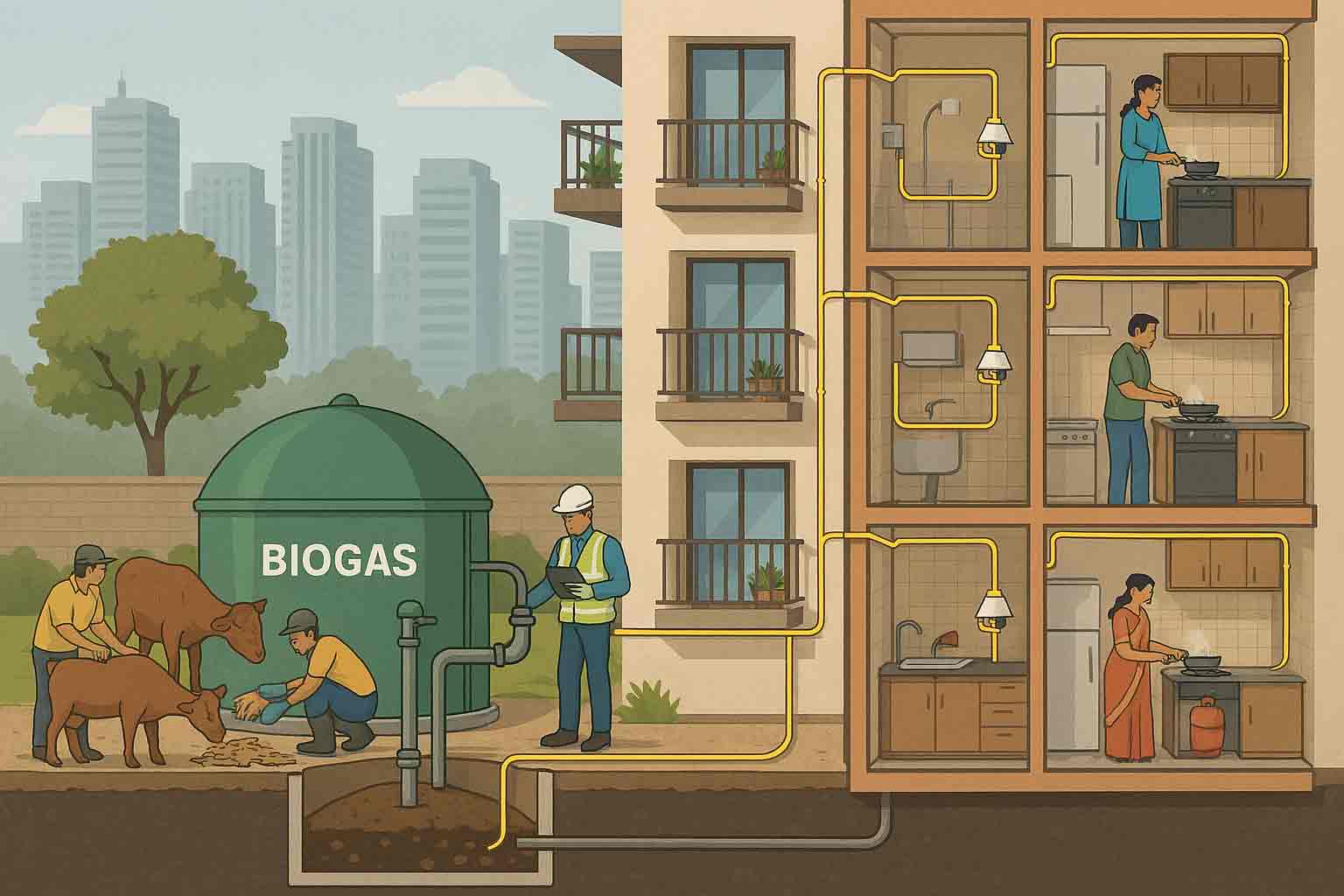
Biogas (gobar gas) plants turn cattle waste into clean cooking fuel and organic manure. The Government of India’s 2021–2026 Biogas Programme (under National Bioenergy Programme) offers significant Central Financial Assistance (CFA) for plants up to 25 – 2500 m³/day. Subsidies range from ~₹9,800 for a 1 m³ plant (general category) to ₹70,400 for a 20–25 m³ SC/ST plant, with an extra ₹1,600 if linked to a toilet or slurry filter. These rates are uniform nationwide, though “hilly/NE/SC/ST” categories get higher amounts. States implement these schemes via rural development/renewables agencies, usually matching MNRE rates (e.g. Maharashtra’s scheme confirms 1 m³ at ₹9,800 general/₹17,000 SC/ST). To apply, beneficiaries register on the MNRE Biogas Portal (for 1–25 m³ projects); larger projects use state channels or the BioUrja portal. Applications require proof of land, cattle, identity, etc. After construction by approved masons (using Deenbandhu fixed-dome or drum models), a state agency inspects and issues a commissioning certificate. Subsidy is then disbursed via DBT to the builder’s loan account or beneficiary’s bank. We detail subsidy norms, state variations, eligibility, application steps, documentation, timelines and inspections (with flowcharts). Cost estimates and financial models are provided for small (0.5–2 m³), household (2–7 m³) and commercial (10–100 m³/CBG) plants (CAPEX, OPEX, payback). Technical designs and material lists for low-cost drum and fixed-dome models are given, along with feedstock requirements and gas/LPG yield calculations. A sample project report outline and checklist (for banks/subsidy) are included. Risks, permits, environmental and safety issues, and a 5-year maintenance schedule are also discussed.
MNRE Biogas Programme Subsidies
The Ministry of New & Renewable Energy (MNRE) implements the biogas subsidy scheme (formerly NBMMP). For small biogas plants (1–25 m³/day), the central subsidy is fixed per plant by capacity. The 2022 guidelines set the following CFA (Central Financial Assistance):
- General States (non-tribal, non-hilly):
1 m³ – ₹9,800; 2–4 m³ – ₹14,350; 6 m³ – ₹22,750; 8–10 m³ – ₹23,000; 15 m³ – ₹37,950; 20–25 m³ – ₹52,800. - Hilly/NER or SC/ST:
1 m³ – ₹17,000; 2–4 m³ – ₹22,000; 6 m³ – ₹29,250; 8–10 m³ – ₹34,500; 15 m³ – ₹63,250; 20–25 m³ – ₹70,400.
In addition, fixed bonuses of ₹1,600 per plant are granted if the biogas unit is linked to a sanitary toilet or an MNRE-approved slurry-filter unit. For example, a 2–4 m³ plant in a general area could get ₹14,350 + ₹1,600 = ₹15,950 in total subsidy. A Deenbandhu-type fixed-dome model typically incurs turn-key fees of ₹3,000 (1–10 m³) or ₹5,000 (15–25 m³) for 5-year O&M warranty.
Larger biogas installations (25–2500 m³) aimed at power/thermal use have per-kW CFA (₹35k–45k/kW), but these are for industrial/CBG projects, not household gobar plants. An extra ₹10,000 incentive is available for biogas engines (10–25 m³ plants) used in farm power/pumping, and special 20% higher subsidies apply in NE, Island, gaushala, SC/ST cases.
Applying for Subsidy: Biogas subsidies are disbursed after construction and commissioning. Beneficiaries (or their financing agency) must first register and apply online on the MNRE Biogas Portal. For 1–25 m³ plants, individual users can apply through the portal/app; state agencies (PIAs) then process these after annual targets are allocated. Plants above 25 m³ (medium projects) are submitted by PIAs on the same portal year-round. No advance subsidy is paid; the government reimburses costs quarterly (small plants via state agency targets) or on completion (large plants). The CFA is credited via Direct Benefit Transfer (DBT) to the installing mason’s loan account or directly to the beneficiary’s bank account upon certification.
Application Process
Proposals must be submitted through the BioURJA Portal.
State-Level Variations
State rural development or renewable agencies implement the scheme with the central guidelines. Most states match MNRE subsidy rates. For example, Maharashtra’s Rural Dev Dept cites the new 2022 rates: 1 m³ – ₹9,800 (general), ₹17,000 (SC/ST); 2–4 m³ – ₹14,350 (gen), ₹22,000 (SC/ST); 5–7 m³ – ₹22,750 (gen), ₹29,250 (SC/ST). (Maharashtra did not list 8–10 m³ separately, but central rates apply.) Kerala, Karnataka, Uttar Pradesh, Bihar, etc. follow the central CFA; some Northeast/hilly states have higher ceilings by default. A few states may offer small additional incentives (e.g. free construction aid in tribal areas), but official state subsidy tables are generally aligned with MNRE. (No major state provides extra biogas subsidy beyond central funds currently.) Users should check their State Nodal Agency (e.g. SRDD, KVIC, RRECs) for any special schemes.
Eligibility
Eligible beneficiaries are typically rural households or institutions with their own land (50–60 m²) and at least two cattle (or equivalent biomass source). Preference is often given to women-headed households, SC/ST families, and households with highest dung output. The plant must be on private or community land (not government-owned). Approved models are required: e.g., the “Deenbandhu” fixed-dome or KVIC floating drum designs are MNRE-approved. When linked to toilets, single households receive an extra incentive.
Application Process
- Registration: Prospective beneficiaries register on the MNRE Biogas Portal (https://biogas.mnre.gov.in/). They fill online forms with details (location, size, cattle count, caste category, bank account, etc.). The local PIA/BDTC (Biogas Dev. Training Centre) allocates targets and mentors the process.
- Site Prep: Ensure a 50–60 m² site (flat/fenced) near the cattle shed. Obtain any local approvals (though small plants rarely need formal permits).
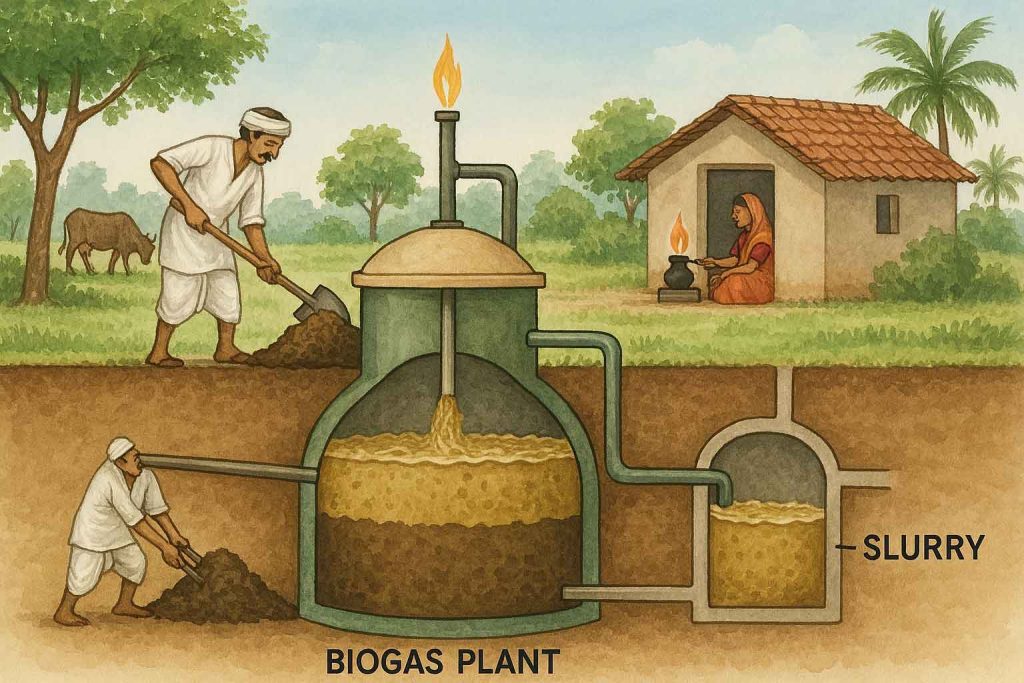
- Construction: Hire an MNRE-certified mason/OEM. Feedstock (cow dung + water) passes through an inlet into the digester. The digester (fixed dome or drum) is built underground, with a slurry outlet and gas pipe to a gasholder or stove. Use specified bricks/cement or HDPE drums as per model.
- Linkages: If claiming toilet bonus, connect the toilet outlet to the digester. If claiming slurry filter bonus, install an approved bio-slurry filter.
- Commissioning: Once built, the PIA (or third-party inspector appointed by MNRE) conducts a physical inspection (mandatory 100%). The plant is commissioned by flushing 1–2 buckets of slurry and lighting the burner. A Completion Certificate is issued upon successful test (biogas flow, stove lit). Commissioning tasks include fitting pipelines, stoves, burners, and a moisture trap.
- Documentation: Submit required papers to the PIA/bank, including Aadhaar ID, address proof, land documents, cattle certificate (Gram Panchayat or Tehsildar attestation), caste certificate (if SC/ST), copies of receipts, and passport photos. The beneficiary receives a Warranty Card for the plant.
- Subsidy Disbursement: After verification, the CFA is released. For self-financed projects, the subsidy is credited via DBT to the bank account of the beneficiary. If a bank loan was taken, subsidy goes to the loan account. Balance cost is borne by beneficiary or state. Subsidy is not front-loaded and is only given post-installation.
Timeline: Construction typically takes 1–2 months. PIA approval and verification may add 1–3 months. In total, 3–6 months from application to subsidy payout is usual. (If targets are unmet, PIA may delay installation.) MNRE guidelines aim for small-plant completion within the financial year of sanction.
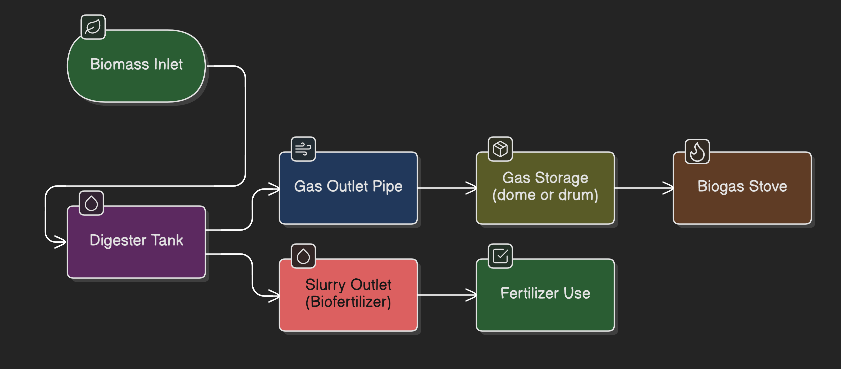
Mermaid flowchart: Simplified biogas process. Cow dung (with water) enters the digester, producing biogas (stored under the dome) and nutrient-rich slurry (biofertilizer). Gas is piped to the stove for cooking.
Costs & Financial Model
Biogas plant costs vary by capacity and design. Approximate CAPEX (materials+labor) and typical CFA are:
| Size (m³) | Approx. Cost (₹) | MNRE Subsidy (₹) | Net Cost to User (₹) | Daily Gas (m³) | Livestock Required |
|---|---|---|---|---|---|
| 0.5–2 (Drum) | 12,000–20,000 | 9,800 (for 1 m³) – 22,750 (for 6 m³) | ~4,000–15,000 | 0.3–0.6 | 2–3 cows (20–30 kg dung) |
| 2–7 (Household) | 25,000–45,000 | 22,750 (5–7 m³) | ~5,000–25,000 | 1.0–2.5 | 5–10 cows (50–80 kg dung) |
| 10–100 (Commercial) | ₹2–20 lakh | (No fixed small-plant CFA) For CBG: ₹3–4 Cr per 4.8 TPD under SATAT; Gobar-Dhan ₹37k/unit in Gujarat (old) | Variable | 5–50+ | Dozens of cows/biomass |
(Figures illustrative: exact costs vary by site and design. “Drum” models use plastic drums; “Fixed-dome” use bricks/cement.)
- Small (0.5–2 m³) drum plants: Low-cost kits (~₹12k–25k) are available. Example: 1 m³ plastic-drum kit ~₹15k (allowing 10–15 kg dung/day, ~0.4 m³ gas/day). Subsidy ~₹9.8k cuts net to ~₹5k. Payback is quick (fuel savings ~₹3–4k/year by replacing LPG).
- Household (2–7 m³) fixed-dome: A typical 5 m³ Deenbandhu plant costs ~₹35k–45k (materials+labor). Subsidy ~₹22,750, net cost ~₹15–25k. This yields ~1.5–2 m³ gas/day (with ~40–60 kg dung/day). That replaces ~3–4 LPG cylinders/year, saving ~₹5,000/yr, yielding 3–5 year payback.
- Commercial (10–100 m³ or CBG): Beyond household, projects become industrial. Subsidies come under other schemes (e.g. Gobar Dhan, SATAT) and can reach crores (e.g. ₹37 lakh per plant in Gujarat*). Such projects have high CAPEX (lakhs to crores) and require formal feasibility/study; see SATAT/CBG guides for details.
Sample Financial Table (5 m³ plant):
| Item | Cost (₹) |
|---|---|
| Digester (bricks, cement) | 25,000 |
| Gas holder (steel/barrel or brick dome) | 10,000 |
| Piping, valves, fittings | 5,000 |
| Burner, stove, fixtures | 5,000 |
| Labor (construction) | 5,000 |
| Total CAPEX | ₹50,000 |
| MNRE Subsidy (5–7 m³ gen) | 22,750 |
| Net Cost | ₹27,250 |
On-going OPEX: Minimal (occasional repairs, cleaning, dirt removal). Feedstock (cow dung) is typically “free” from one’s cattle (or paid to neighbours).
Payback: With ~2 m³/day (2 cow input), annual LPG saving = 2 m³/day × ~0.5 kg LPG-equivalent/m³ × 350 days × ₹60/kg ≈ ₹21,000. Thus ~1–1.5 years payback on net cost. Even slower-case (1 m³/day) still recoups in 2–3 years.
Technical Design & Materials
Low-Cost Drum Model: Uses two recycled drums (200–500 L). One acts as the digester; the other (inverted) as a floating gasholder. Materials needed: two plastic barrels, PVC inlet/outlet pipes, one-way valve, biogas stove, and a sturdy stand. These kits (1.5–2 m³) cost ₹15k–20k. They’re portable but need sunlight (plastic drum can overheat) and are mainly for 1–2 cows’ worth of dung.
Figure: Example hand-drawn schematic of a small DIY biogas digester (floating drum design). Organic waste enters the digester (A), produces gas (C) collected under the floating tank (D), and the effluent (B) becomes fertilizer.
Fixed-Dome (Deenbandhu) Model: Traditional design with a below-ground digester and a brick/steel dome that stores gas under pressure. Materials: bricks or poured concrete for the dome and digester, coarse sand, cement, reinforcement steel, inlet and outlet PVC pipes (dia ~80–100 mm), a slurry outlet, gas outlet pipe, safety valve (bubbler), and a metal stove burner. The dome is plastered with cement (sometimes coated with water-pozzolan mix for waterproofing). Builders often use locally available “Deenbandhu” drawings and kits. A 5 m³ brick plant might need ~600 bricks, 1.5 t sand, 0.5 t cement, and steel rods for reinforcement. See MNRE model specs for exact schedule of materials (approx. Rs.500–800 per m³ for civil works).
Feedstock & Yield
Biogas yield depends on feedstock quality. Cow dung: 1 kg produces ~15–30 L of biogas per day. Thus ~20 kg dung (2–3 cows daily) yields ~0.3–0.6 m³ of biogas (enough for 2–3 hours of cooking). A 5 m³ plant digesting ~50 kg dung/day can generate ~1.0–2.0 m³/day. This roughly equals ~0.5–1.0 kg LPG per day (1 m³ biogas ≈ 0.45 kg LPG equivalent). For perspective, a 14.2 kg LPG cylinder contains ~30 m³-equivalent; thus 1–2 m³/day covers 12–24 days of LPG. Biogas composition is ~60% methane, so it has a heating value (~21 MJ/m³).
Daily feedstock (dung + water) is about 10–15 kg dung and 50–100 L water per 1 m³ of biogas. Water (urine, greywater, or handpump water) is needed to slurry the dung (typically 1:1 ratio by volume). In summer, mix density can be lower (more water) to cool the digester.
Gas Purity: Biogas contains methane, CO₂ and trace H₂S. For domestic use, no further purification is needed other than a moisture trap. If planning a generator or pipeline, scrubbing (iron sponge, NaOH filters) may be used.
Project Report & Checklists
A formal project report (for loans or approval) should include:
- Executive Summary: Project aims (clean fuel, bio-manure, income), key numbers (capex, capacity, subsidy, payback).
- Background/Need: Fuel cost, dung availability, environment issues (odor, smoke) being addressed.
- Project Description: Location, plant size and type (Drum or Fixed Dome), feedstock source, beneficiaries (e.g. 1 farm, 5 villages, 2 ghoshalas).
- Implementation Plan: Timeline (illustrated by Gantt), tasks and responsibilities (site prep, civil works, piping, commissioning).
- Technical Design: Diagrams (like above), material schedule, equipment list (stove, pipeline).
- Cost and Financing: CAPEX breakdown table, subsidy/subventions, equity and loan. Example:ItemQtyCost (₹)Digester (bricks/cement)1 unit (5 m³)30,000Gas holder (dome/drum)1 unit10,000Fittings & valves–3,000Burner & pipe to kitchen–3,000Labor/installation–10,000Total56,000Subsidy (MNRE: ₹22,750) → Net ₹33,250. Loan: ₹30,000; Equity: ₹3,250.
- Operation & Economics: Estimate biogas production and its LPG-equivalent value; mention byproduct slurry sale potential. Compute yearly savings vs costs (maintenance 2–3% of CAPEX). Show IRR/payback (usually 3–5 years for household plants).
- Environmental Impact: Soil fertility (slurry NPK), emission reduction (methane captured), reduced smoke exposure.
- Risk & Mitigation: Summarize key risks (dung shortage, structural leak, fire hazard) and mitigation (alternate feedstock, regular checks, flame trap).
- Maintenance Plan: Outline routine: monthly cleaning of inlet, quarterly check of dome sealing, annual overhaul.
A checklist for banks/subsidy might include: land ownership proof, cattle declaration, Aadhaar, caste certificate, project plan sketch, quote from mason, and no-objection for water use (if any).
Permits, Safety, Maintenance and Risks
- Permits: Small gobar plants usually need no special permits. However, if under an NGO/state scheme, a certificate from the PIA is required. If using toilets, hygiene norms apply (DPHE or Urban Sanitation Dept). Large/CBG projects need EPA or PCB clearances.
- Safety: Biogas is flammable. Install flame arrestors/bubblers in gas lines. Keep stove burners in good repair; avoid leaks (soapy water test). The digester must be gas-tight; repair cracks promptly. Biogas contains toxic H₂S in trace; prolonged exposure is harmful. Ensure good ventilation around the kitchen pipe. Never allow open flame near the digester or gas lines when filling slurry.
- Maintenance: Inspect the dome and pipes monthly for cracks or corrosion. Clean the inlet filter and slurry outlet pipe quarterly. Replace stove burners if soot-clogged. Every year, check the airtightness by pressurizing gently with a bicycle pump while submerged.
- Risks: Inadequate feedstock (e.g. disease among cattle) reduces gas yield; plan alternate inputs (kitchen waste, urine). Pest/rodent damage or plant misuse (overloading fresh waste) can clog pipes. Financial: if the biogas demand drops (e.g. user absence), methane escapes. Insurance of major components can mitigate fire/bursting risks.
Health & Environmental Benefits: By capturing methane (a potent GHG), biogas plants cut climate impact. Using clean biogas instead of wood or kerosene also reduces indoor air pollution (improving women’s health). The anaerobic process treats waste, reducing pathogens; the digestate is a pathogen-poor fertilizer that enriches soil naturally.